
Embedded AI Solutions That Put Intelligent Decision-Making Directly Inside Your Devices
Embedded AI & Edge AI Development Services — Intelligence Where It Matters Most
The cloud can’t always be there. Sensors can’t wait. Machines can’t afford a round trip to a data centre before making a critical decision. That’s why AI Media Labs, a globally trusted Edge AI Deployment Company, builds intelligence directly into your devices, systems, and infrastructure. Our Edge AI Development Services deliver real-time AI inference at the point of action — reducing latency, protecting data privacy, cutting bandwidth costs, and enabling autonomous operations in environments where cloud connectivity is limited, slow, or simply not enough.
Our Core Embedded AI
&
Edge AI Development Services
On-Device AI Model Development and Optimization
Edge AI Deployment for IoT Devices
Embedded Systems AI Integration
Edge AI for Computer Vision Applications
Predictive Maintenance and Anomaly Detection at the Edge
Hybrid Cloud-Edge AI Architecture Design
Key Challenges In
Embedded AI & Edge AI Development
Power Consumption and Energy Constraints
Hardware Diversity and Fragmentation
Model Compression and Accuracy Trade-offs
Edge Orchestration and Fleet Management
Connectivity and Network Reliability
Security and Data Privacy at the Edge
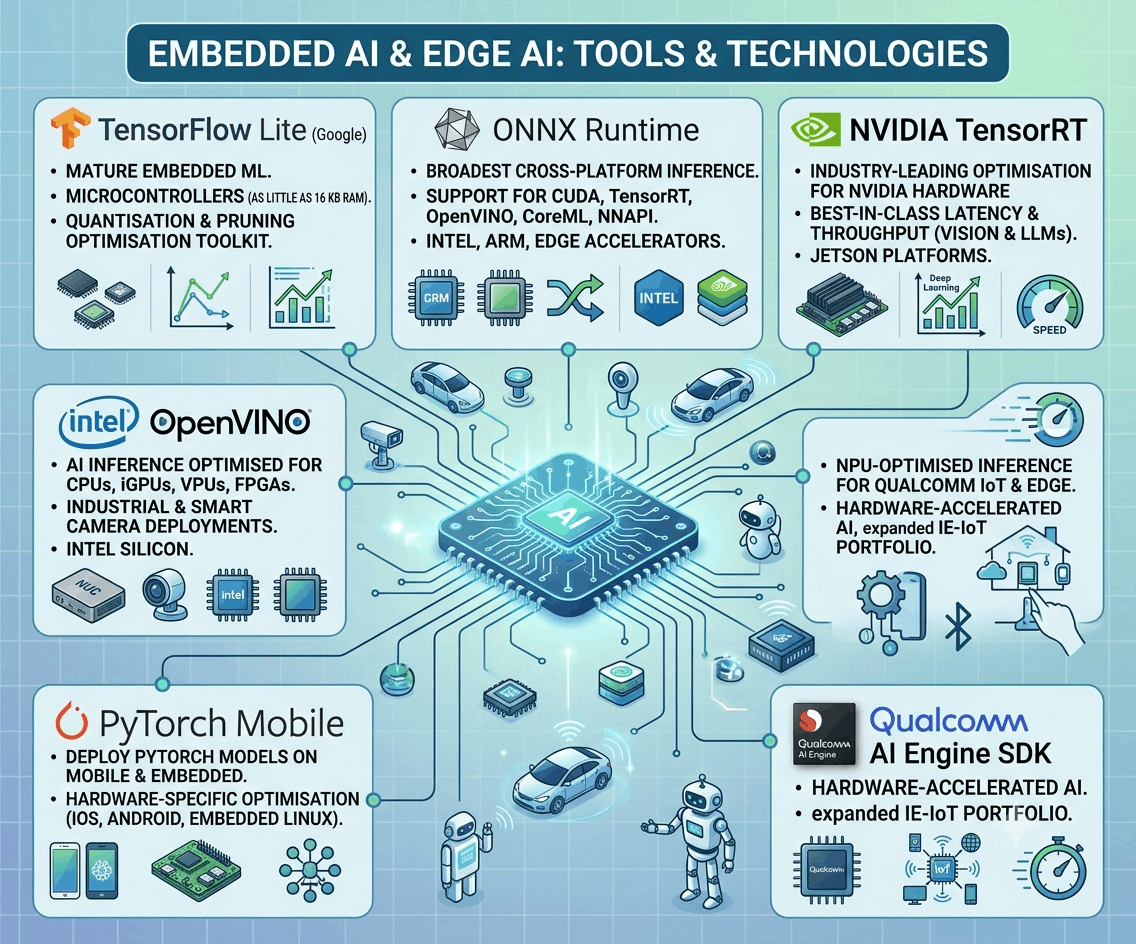
Our Comprehensive Tools and Technologies for Embedded AI & Edge AI Development
Use Cases & Real-World
Embedded AI & Edge AI Success Stories
PepsiCo — 90% Defect Detection with 20% Throughput Gains
Mercedes-Benz — NVIDIA Autonomous Platform Adoption
Boston Dynamics Atlas — Automotive Assembly Automation
Healthcare — Real-Time Patient Monitoring at the Edge
Warehouse Robotics — 200 Picks Per Hour vs. 80 Manual
Retail Smart Cameras — Edge AI for Loss Prevention
Why Choose AI Media Labs
for Embedded AI & Edge AI Development?
Embedded AI & Edge AI Development Services
There’s a version of AI that lives in the cloud — vast, powerful, and permanently dependent on a stable internet connection. And then there’s edge AI: intelligence that lives in the device, processes data where it’s generated, and makes decisions in milliseconds without waiting for a server response thousands of miles away.
At AI Media Labs, the Edge AI Deployment Company that engineers and enterprises across manufacturing, healthcare, automotive, logistics, and smart infrastructure trust worldwide, we build the second kind. Our Edge AI Development Services are designed for the real world — environments where latency cannot be tolerated, connectivity cannot be guaranteed, and data privacy cannot be compromised.
The Edge AI Market Opportunity Is Accelerating
The global edge AI market was valued at $11.8 billion in 2025 and is forecast to reach $56.8 billion by 2030 at a CAGR of 36.9% — one of the fastest-growing technology markets globally. This growth is driven by three converging forces: the explosion of IoT device deployments generating more data than the cloud can efficiently process, the maturation of NPU-equipped edge hardware from Qualcomm, NVIDIA, Intel, and ARM that makes on-device inference economically viable, and the tightening of data privacy regulation worldwide that makes local processing not just a performance choice but a compliance imperative.
2026 marks the inflection point where edge AI moves from early pilot to broad enterprise deployment — and organisations that build their edge AI capability now will hold a significant operational advantage over those that arrive late.
What Our Edge AI Development Services Actually Deliver
Our process begins with an edge deployment audit — a thorough assessment of your target devices, operating environment, connectivity profile, power budget, latency requirements, and data privacy constraints. This audit directly informs every technical decision that follows: model architecture, framework selection, hardware target, compression strategy, and deployment pipeline design.
This matters because the most common edge AI failure mode is not a bad model — it’s a good model deployed on the wrong hardware with the wrong optimisation strategy, in an environment it was never validated against. AI Media Labs eliminates that failure mode before development begins.
On-Device AI Model Optimisation: The Core Engineering Challenge
The single biggest technical challenge in edge AI is fitting a capable AI model into the constraints of edge hardware — limited RAM, limited compute, limited power — without degrading it to the point of uselessness. Our On-Device AI Model Optimisation practice addresses this through a structured, iterative process.
Quantisation converts model weights from 32-bit floating point to 8-bit or 4-bit integers — reducing model size by 4–8x with minimal accuracy loss when applied correctly. Pruning removes redundant neurons and connections from trained models, reducing computational load without significantly affecting output quality. Knowledge distillation trains a smaller “student” model to replicate the behaviour of a larger “teacher” model — producing compact, efficient models that retain the intelligence of their larger counterparts. Hardware-specific tuning then adapts the optimised model to the execution characteristics of your target NPU, DSP, or accelerator, squeezing maximum performance from available silicon.
The result is an AI model that meets your accuracy requirements, fits within your device’s memory and power budget, and performs consistently in real-world deployment conditions — not just in a benchmarking environment.
AI for IoT Devices and Edge Computing: Applications Across Industries
Our AI for IoT Devices and Edge Computing expertise spans the full range of industrial and commercial applications where on-device intelligence delivers the clearest value.
In manufacturing, edge AI enables inline quality inspection at production throughput, predictive maintenance from vibration and thermal sensor streams, and process optimisation driven by real-time machine data — all without routing sensitive operational data through external cloud infrastructure. In healthcare, embedded AI on medical wearables and diagnostic devices monitors patient vital signs continuously, flags anomalies for clinical review in real time, and maintains strict data locality for HIPAA and GDPR compliance. In logistics and warehousing, AI-powered autonomous mobile robots use on-device perception to navigate dynamic environments, pick items, and coordinate with other robots — delivering throughput gains that manual operations cannot match. In retail, smart cameras running on-device computer vision monitor shelves, detect unusual behaviour, and analyse customer flow — all processed locally, with no cloud latency and no unnecessary data transmission.
Embedded AI Solutions: From Prototype to Production Fleet
Getting a single edge AI device to work is one challenge. Getting ten thousand of them to work reliably, stay updated, and remain secure over a multi-year operational lifecycle is a different and significantly harder challenge.
AI Media Labs builds the MLOps and device management infrastructure that makes the difference. Our edge deployment pipelines include OTA model update capability, remote performance monitoring, automated anomaly detection when device behaviour deviates from baseline, and rollback mechanisms that restore previous model versions when updates cause unexpected degradation. Our Embedded AI Solutions are engineered for the full operational lifetime of your device fleet — not just for the first successful deployment.
The Hybrid Edge-Cloud Architecture Advantage
The smartest edge AI architectures don’t force a binary choice between edge and cloud. They distribute intelligence intelligently: fast, frequent, latency-sensitive decisions — object detection, anomaly flagging, immediate safety response — run at the edge with zero cloud dependency. Complex, infrequent, data-intensive tasks — model retraining, fleet-wide analytics, long-range forecasting — run in the cloud where compute is abundant. AI Media Labs designs and implements these hybrid architectures, ensuring your organisation gets real-time responsiveness at the edge and the analytical depth of the cloud — without the limitations of either approach alone.
Frequently Asked Questions
Edge AI processes data and runs AI inference directly on local devices — cameras, sensors, robots, medical equipment — rather than sending data to remote cloud servers. This eliminates network latency, reduces bandwidth costs, improves data privacy, and enables AI to function reliably without internet connectivity.
Manufacturing, healthcare, automotive, logistics, retail, agriculture, energy, and defence all benefit significantly. Any industry with real-time decision requirements, sensitive local data, connectivity constraints, or distributed equipment fleets is a strong candidate for edge AI deployment.
We develop and optimise for NVIDIA Jetson, Qualcomm IE-IoT platforms, Intel Neural Compute Stick and OpenVINO-compatible hardware, ARM Cortex-M and Cortex-A series, Raspberry Pi and equivalent SBCs, FPGAs, and custom SoC architectures — selecting the optimal platform for each use case.
We apply iterative quantisation-aware training, structured pruning with accuracy benchmarking at each step, and hardware-in-the-loop validation — testing every compressed model against production-representative data on the actual target hardware before deployment sign-off.
Yes. Our edge deployments incorporate secure boot, encrypted model storage, encrypted data-at-rest and in-transit, role-based access controls, and tamper-resistant firmware — ensuring models and local data are protected against both physical and network-based threats.
It is the engineering process of reducing an AI model’s size and computational demand — through quantisation, pruning, and distillation — so it can run accurately within the power and memory constraints of edge hardware. Without it, capable AI models simply cannot run on edge devices in real time.
Simple single-device deployments typically take 4–8 weeks from design to production. Complex multi-device, multi-model systems with custom hardware integration and fleet management infrastructure typically take 3–6 months. AI Media Labs provides a detailed timeline and phased delivery plan at the start of every engagement.