
World-Class Computer Vision Development Services That Turn Visual Data into Business Intelligence
Computer Vision Development Services — Teaching Machines to See, Think, and Act
Your cameras already capture everything. The question is whether your business is doing anything intelligent with that data. At AI Media Labs, a globally trusted Computer Vision AI Company, we build systems that don’t just record the world — they understand it. From real-time defect detection on production lines to medical image diagnostics and autonomous retail analytics, our Computer Vision Development Services turn visual data into business decisions, at speed and at scale.
Our Core Computer Vision
Development Services
Custom Computer Vision Model Development
Object Detection and Image Recognition Services
Video Analytics and Intelligent Surveillance
Medical Image Analysis
Industrial Quality Control Vision Systems
Facial Recognition and Biometric AI
Key Challenges In
Computer Vision Development
Data Annotation Quality and Scale
Model Accuracy in Real-World Conditions
Domain Shift and Generalisation
Edge Deployment and Latency
Data Privacy and Regulatory Compliance
Scalability from Pilot to Production
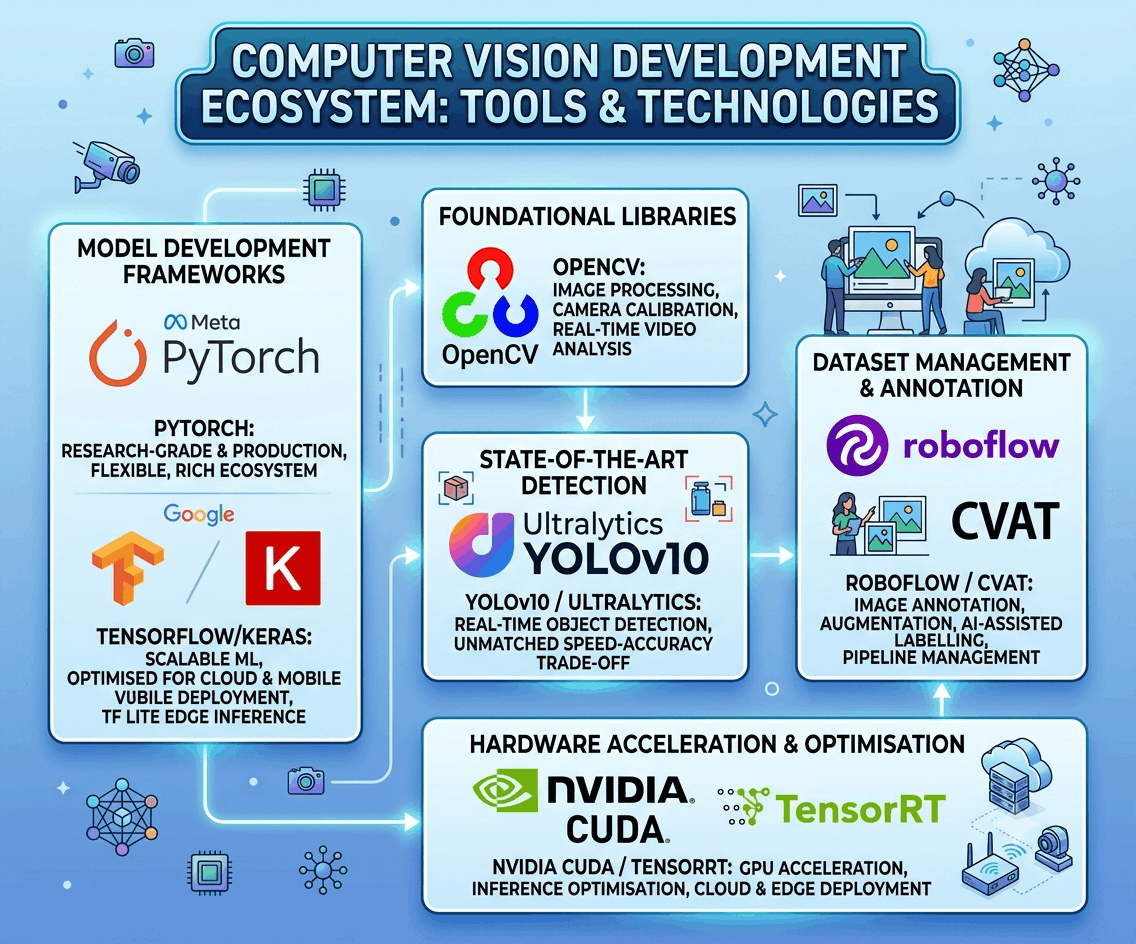
Our Comprehensive Tools and Technologies for Computer Vision Development
Use Cases & Real-World
Computer Vision Success Stories
Tesla Autopilot — Real-Time Object Detection at Highway Speed
Amazon Go — Cashierless Retail via Computer Vision
Google DeepMind — AI Detecting Eye Disease from Retinal Scans
Cognex — $994 Million in Machine Vision Revenue
Manufacturing Quality Control — 37% More Defects Detected
Walmart — Shelf Intelligence at Scale
Why Choose AI Media Labs for
Computer Vision Development Services?
AI Computer Vision Software Development
There’s a moment in almost every conversation with a new client when something clicks. They describe a problem — inspectors missing microscopic defects, customers walking past empty shelves, clinicians overwhelmed by imaging backlogs, security teams reviewing hours of footage for incidents that already happened. And then they ask: can AI actually see this?
The answer, increasingly, is yes. And at AI Media Labs, the Computer Vision AI Company that businesses across manufacturing, healthcare, retail, logistics, and security trust for production-grade vision systems, our job is to make that yes reliable, accurate, and commercially valuable.
The Scale of the Computer Vision Opportunity
The global computer vision market is projected to reach $24.14 billion in 2026, growing to $72.80 billion by 2034 at a 15% CAGR. What’s changed is deployment maturity — computer vision is no longer a research discipline or a pilot programme. Organisations running production systems at scale are seeing measurable returns: AI quality inspection detects 37% more defects than human inspectors, retail shelf-monitoring cuts out-of-stock events by up to 30%, and medical imaging AI diagnoses conditions at speeds no clinical team can match manually.
What Our Computer Vision Development Services Cover
AI Media Labs delivers Computer Vision Development Services across the full technical stack — from the raw image pipeline through deep learning model development, deployment infrastructure, and ongoing performance management.
Our process begins with a visual intelligence audit. Before building anything, our engineers analyse your visual environment: camera setup, lighting conditions, object variability, scene complexity, required inference speed, and edge versus cloud deployment constraints. This environment analysis directly informs model architecture selection, training data requirements, and deployment strategy — preventing the costly mismatches that cause vision projects to underperform in production.
Custom Computer Vision Model Development: Why Generic Models Fail
Off-the-shelf computer vision APIs work for general use cases — identifying common objects in standard images. They consistently underperform for industrial, medical, or domain-specific applications where your objects are unusual, your environments are controlled but specific, or your accuracy requirements exceed what general models are trained to deliver.
Our Custom Computer Vision Model Development practice builds models from the ground up on your data, in your environment, for your specific visual task. This means custom training datasets curated and annotated for your object categories and edge cases, transfer learning from foundation models adapted to your domain, and iterative evaluation against real production conditions before deployment.
The result is a model that understands your specific world — not the average of the internet’s images.
Object Detection and Image Recognition Services: Real-Time, High-Precision
Our Object Detection and Image Recognition Services deploy systems capable of identifying, localising, and classifying multiple objects simultaneously in real-time video streams at production throughput. We implement the latest YOLO architectures for applications requiring speed, and transformer-based detection models where precision in complex, cluttered scenes is the priority.
For industrial quality control, this means inline inspection systems that run at conveyor speed — catching dimensional defects, surface anomalies, missing components, and contamination with sub-millimetre precision. For retail, it means shelf monitoring systems that track product placement, identify out-of-stock positions, and feed replenishment systems in real time. For security and access control, it means perimeter monitoring that distinguishes people from animals and vehicles, triggers alerts for defined behaviours, and maintains zero-latency response across camera networks.
Medical and Healthcare Computer Vision
Healthcare is among the highest-value domains for computer vision. Our medical imaging AI systems are trained on validated clinical datasets to assist with diagnostic tasks across radiology, pathology, ophthalmology, and dermatology — detecting anomalies, segmenting structures, and generating preliminary analysis that supports clinicians without replacing them. Every system is built with clinical validation methodology, explainability, and regulatory alignment from the outset.
From Model to Production: The Engineering That Actually Matters
Training a computer vision model that works is one challenge. Deploying it reliably in a production environment — handling real camera variability, integrating with existing operational systems, maintaining accuracy over time as conditions change, and scaling from one camera to thousands — is a different and harder challenge.
AI Media Labs specialises in the production engineering that makes the difference between a compelling demo and a system your operations can depend on. We deploy vision models using NVIDIA TensorRT for GPU-accelerated inference, TensorFlow Lite for edge device deployment, and cloud-native architectures for scalable multi-camera deployments. We instrument every production system with confidence monitoring, automated retraining triggers, and alerting when model performance drifts below defined thresholds.
Industry Applications AI Media Labs Serves
Our AI Computer Vision Solutions are deployed across manufacturing, retail, healthcare, logistics, agriculture, construction, and security. In every domain, the principle is the same: visual data that was previously captured and discarded becomes operational intelligence — driving faster, more accurate, more consistent decisions at scale.
Frequently Asked Questions
AI computer vision is the field of artificial intelligence that enables machines to interpret and understand visual information from images and video. Using deep learning models trained on labelled image data, computer vision systems can detect objects, recognise faces, read text, analyse medical scans, inspect products, and monitor environments — often with accuracy that matches or exceeds human performance.
AI Media Labs develops object detection and tracking systems, image classification models, semantic and instance segmentation systems, facial recognition and biometric verification, optical character recognition (OCR), medical image analysis tools, video analytics platforms, and industrial quality inspection systems — across cloud, on-premise, and edge deployment environments.
Our primary stack includes PyTorch and TensorFlow for model development, OpenCV for image processing, YOLO architectures for real-time detection, Roboflow and CVAT for data annotation, and NVIDIA CUDA and TensorRT for production inference optimisation — on cloud infrastructure or edge hardware depending on latency and deployment requirements.
Object detection models process an image through a convolutional neural network that simultaneously predicts bounding boxes around objects and assigns class labels and confidence scores to each box. Modern architectures like YOLO process the entire image in a single forward pass — enabling real-time detection at video frame rates with high accuracy across multiple object categories simultaneously.
We serve manufacturing and quality control, retail and e-commerce, healthcare and medical imaging, logistics and warehousing, agriculture, construction, security and surveillance, and automotive — providing domain-adapted models and production-ready deployment for each sector’s specific visual intelligence requirements.